Copyright and reproduction policy
Yours truly
BUILDING A SMALL OBSERVATORY
I started thinking about building a small observatory almost immediately upon getting my first telescope in 1997. Most of these thoughts were pretty undirected, however, since my corner of Marin County, California (my primary residence) is quite light polluted and surrounded by tall trees. I saved my major viewing and astrophotography activities for star parties and occasional trips to darker parts of the county.
When it became apparent that I was going to spend a lot of time in astrophotography, I decided to do some looking around for a place that could be used on weekends and evenings when conditions were good. My wife and I started reading the real estate ads and driving around northern Marin and adjacent southern Sonoma County. We found nothing in Marin and very little in southern Sonoma. One very pretty place turned out to have severe light pollution from Santa Rosa. So we looked farther north, and finally found a place in the wine country near Healdsburg. This site has a fairly dark sky overhead (although some light pollution from both Santa Rosa and Healdsburg is present). There are no high hills or trees nearby, so the sky is not obstructed. Finally, it is just about an hour's drive on a main road from our primary residence, so getting there is easy (except during commute hours).
Planning. I immediately started planning an observatory for the site and ordered the book, Small Astronomical Observatories, by Patrick Moore. My reading of the magazines, checking the web, and the book indicated that a roll-off roof was the most practical approach for something in the 8x10 foot size range. (Like many do-it-yourself projects, both the roof type and the size were modified before I was done.) The most important part of an observatory for astrophotography is the telescope mounting, so I started by planning the pier on which my original 8 inch fork-mounted Schmidt-Cassegrain, equatorial Losmandy G-11, and future mounts would be placed. I designed a 12 inch concrete cylinder set far enough in the ground to provide good stability with an aluminum plate arrangement on top for bolting the mount. The building around it would consist of simple 2x4 frame construction set on a standard 2x8 floor structure covered with plywood. Nothing fancy involved. I went to a big hardware/builders' supply store and ordered what I thought I would need so that they could deliver it to the site.
Building it. The first thing I discovered in trying to dig the hole for the pier was that the soil in the wine country consists mostly of rocks—very large rocks! I couldn't get more than a foot down with pick and shovel. Off to the tool rental store, where I found a neat electric jack-hammer. This did a good job on the rocks and I finally got the four-foot hole dug. I put some rebar (iron reinforcing bars) in the hole and set a piece of 12 inch sonotube over the bars and started mixing concrete. 18 bags of QuikCrete later I had a 1080 pound pier (not counting the water used in mixing the concrete) with a nice mounting plate embedded in the top. See Pier & Mounting Plates.
Figure 1
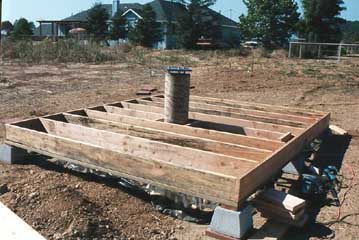 After allowing a week for the concrete
in the pier to settle and cure, I got started on the framework. The floor (suitably isolated
from the pier, of course) came together very quickly (Figure 1). Then the walls
went up. By this time I had realized that I wanted something a little more
presentable than plain plywood or OSB (oriented strand board) walls, so I added some grooved exterior paneling
on top of the OSB (Figure 2).
After allowing a week for the concrete
in the pier to settle and cure, I got started on the framework. The floor (suitably isolated
from the pier, of course) came together very quickly (Figure 1). Then the walls
went up. By this time I had realized that I wanted something a little more
presentable than plain plywood or OSB (oriented strand board) walls, so I added some grooved exterior paneling
on top of the OSB (Figure 2).
A new concept in roofs. All this time I had been thinking about the roll-off roof: how much would it weigh, how easy would it be to roll it, how to keep it from blowing off, and so on. While scanning the Internet one night, I noted a report on a new personal observatory on the web site of the Victoria (British Columbia) amateur astronomy club. Eric Schandall had invented a new kind of roof: one that opens like a clamshell; it unfolds. Pictures of his observatory are in the February 1999 issue of Sky & Telescope (which also has a lot of other unusual observatory designs).
The fold-off roof idea appealed to me: it avoided the problem of the massive supports needed to hold a roll-off roof when it is rolled back, and it looked really cool. I went for it. There was a scaling problem: Schandall's observatory is 8x8 feet, so its roof (framework and roof panels) could be made from steel and still be manageable. My observatory had already inflated from the original 8x10 feet to 10x12, so the roof was going to be pretty big. Each half of the folding roof would have to be about 6 by 14 feet to allow for some overhang, and in steel that would be a mighty heavy piece of stuff to move around. On the other hand, aluminum is one third the weight of steel, so that seemed a lot more practical. By the way, more photos of the construction can be found below in a separate, larger file.
Who sells custom-made aluminum clamshell roofs? Getting an aluminum roof built was the next problem to be solved. I was perfectly comfortable about building the concrete and wood infrastructure of the observatory, but it seemed to me that with all the aluminum awning and roofing companies in Northern California, it would be easy to find someone to fabricate my little 6 by 14 foot panels. I was wrong: after going through two phone books and calling almost a dozen places, I found only one company willing to bid on the project. When the bid came through, it was about three times what I had expected. Time to rethink the project.
| I still really liked the idea of the fold-off roof. So I decided to build it myself. I found a metal supplier nearby who could provide the various kinds of aluminum needed for the structure and went to work. It turned out to be pretty easy, given a few power tools. The aluminum fasteners that are available now (self-tapping screws and rivets) make things very straightforward. So I ended up with two roof panels, each 6 by 14 feet and weighing about 130 pounds. (I completed the assembly of the panels on the observatory, so I didn't have to lift 130 pounds up onto the top of the structure.) | 
Figure 2. Observatory, roof open |
However, if roof panels are going to be folded and unfolded on a nightly basis, there has to be some way of handling these very heavy things. This got me---for the first time in my life---into purchasing some body-building equipment.
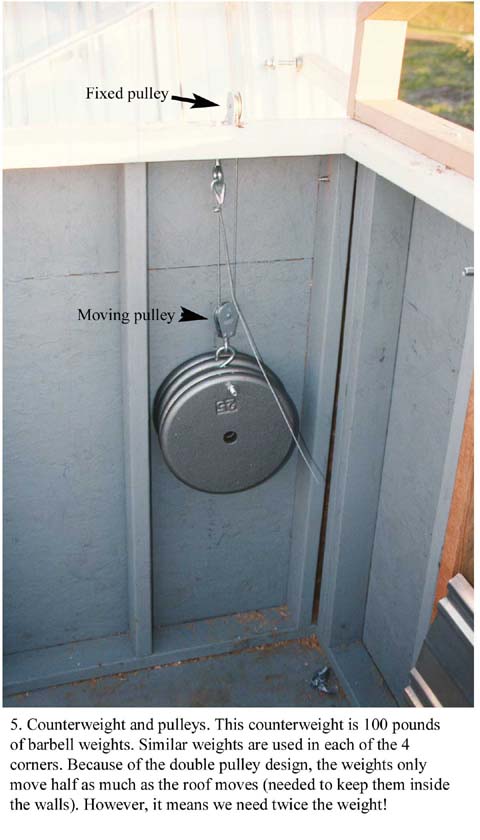 Metal Muscles for astronomy. I
was not interested in building up my own body enough to toss those roof panels
around—that just didn't seem likely to happen. However, counterweights can be
used to balance heavy objects: an analogous application is the use of sash weights
on heavy double-hung windows. Where to get 400 pounds of weights? Well, the
fitness store, obviously! Those big round things on barbells come in various
weights, up to 50 pounds apiece or more. It turned out that the 25 pound size
was pretty manageable, so I bought 400 pounds worth (I think I temporarily
cleaned out the supply in San Rafael). They are now installed, with appropriate
pulleys and cables to transmit the weight in the proper places and directions.
Metal Muscles for astronomy. I
was not interested in building up my own body enough to toss those roof panels
around—that just didn't seem likely to happen. However, counterweights can be
used to balance heavy objects: an analogous application is the use of sash weights
on heavy double-hung windows. Where to get 400 pounds of weights? Well, the
fitness store, obviously! Those big round things on barbells come in various
weights, up to 50 pounds apiece or more. It turned out that the 25 pound size
was pretty manageable, so I bought 400 pounds worth (I think I temporarily
cleaned out the supply in San Rafael). They are now installed, with appropriate
pulleys and cables to transmit the weight in the proper places and directions.
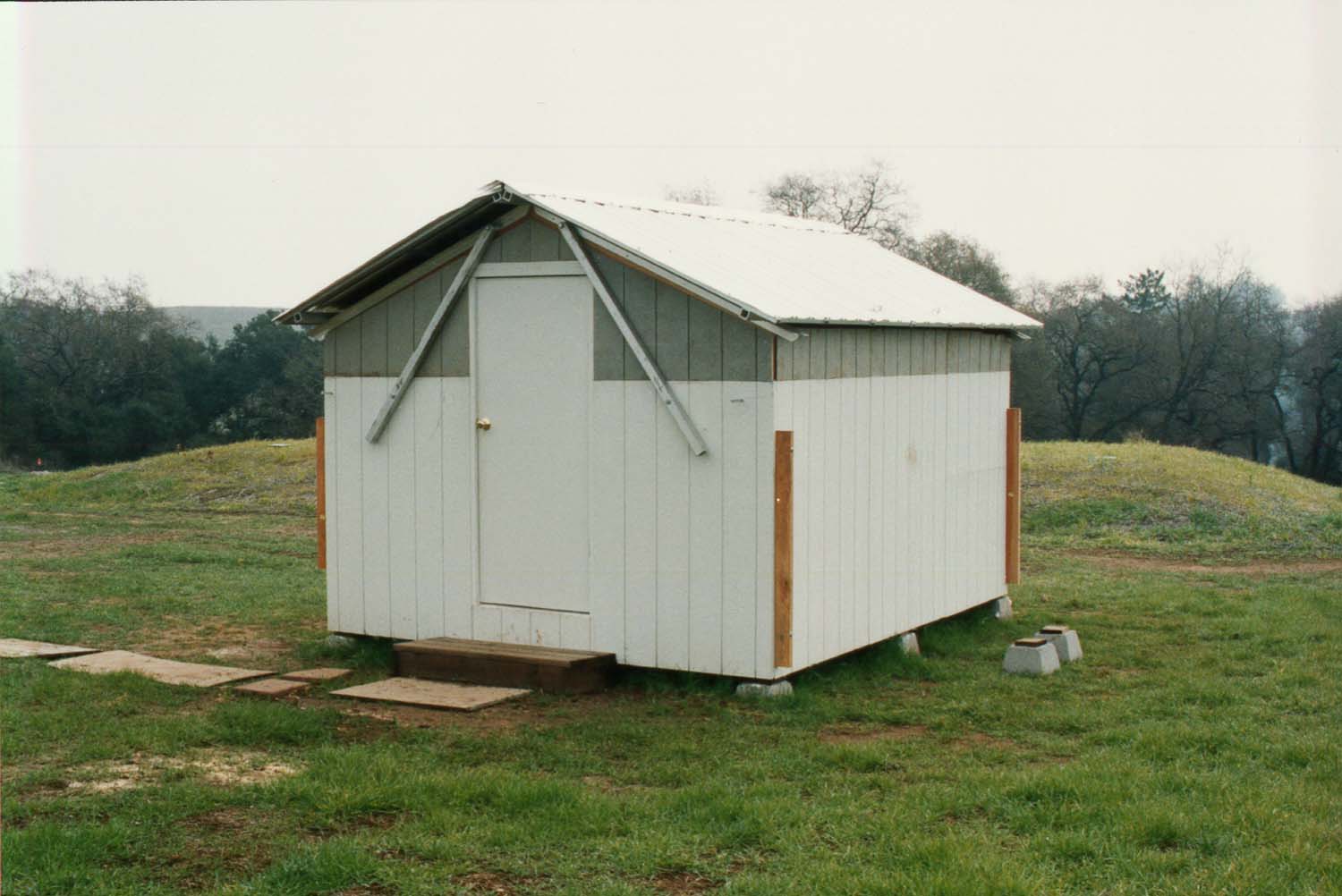
Trying it out. It's been "almost finished" now since 1998. The figures show the completed observatory, open and closed. I've used it regularly and have no major problems with any aspect. There is a lot of airflow under the eaves preventing too much heat build-up, even on 100-degree days, but it remains surprisingly dry even during heavy rains. Dust does blow in,
|
so I keep the optics capped or in the house when I'm not using them, but everything else lives out in the observatory quite happily. I have added hinges to the south gable (gray area in figure 2) so that it swings down over the tops of the pivot bars, leaving the southern horizon completely open. So it looks like the investment (about $2500 in the observatory) and all the sweat have been worth while! One last photo is here: yours truly in the observatory. |
Figure 4. Observatory, roof closed.
|
I will be happy to provide additional details or better photos by e-mail to anyone thinking of a similar project.mailto:katzung1@comcast.net
Pier & Mounting Plates More observatory construction photos (but a very large file!)